 Skip to main content



An extension of Amazon’s shopping app, AR View, allows users to virtually place products from the store in their environment. “Augmented reality (AR) is a technology that has been around for several years, but has only recently become popular in online retail. As a seller on Amazon, you should take a very close look at Amazon Augmented Reality View. Here is an overview.
What is Amazon AR View?
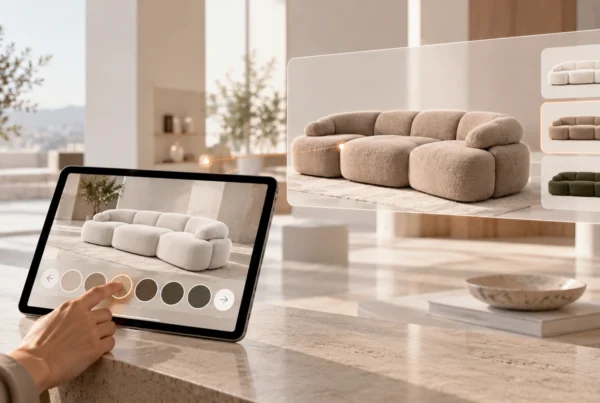
Customers can use the AR View feature on smartphones or tablets to view products from Amazon’s extensive range in their own home, office or any other location, as if they were actually there. The device’s camera captures the user’s real surroundings and then overlays virtual models of the selected products in real time. Before buying a product, customers get a realistic and interactive idea of how it would look and fit in their own environment. Amazon AR View therefore offers a completely new shopping experience that supports customers in their decision and reduces the risk of a wrong purchase.
The newest feature of Amazon AR View is the virtual shoe try-on. It lets customers try on sneakers virtually – however, the feature is initially only available for iOS and in the USA.
How can I benefit from this as a retailer?
Amazon AR View offers retailers many advantages. Firstly, it allows them to display their products in an innovative and appealing way. Retailers can personalise the shopping experience and give customers a better understanding of the products. This can increase customer satisfaction and boost the conversion rate. Secondly, Amazon AR View reduces the return rate for retailers. Customers can better assess whether a product meets their needs if they have the opportunity to test it in their own environment before buying. This reduces the likelihood of inadequate or unsatisfactory purchases and leads to fewer returns.
In addition, Amazon AR View enables retailers to stand out from the competition and present their products in an innovative way, which can lead to an increase in brand awareness and sales.

Source: Amazon
Activate Amazon AR View
It is fairly easy for retailers to activate Amazon AR View for their own products. To use Amazon AR View, follow these steps:
- First, retailers need to make sure they have a professional seller account on Amazon. Only professional sellers can use Amazon AR View.
- Retailers then need to make sure their goods are suitable for AR View. Currently, not all products are compatible with AR View. Items such as furniture, household appliances, electronics, toys and others are usually particularly well suited to AR.
- After selecting the products, retailers search the product list in their seller account and select the product for which they want to activate AR View.
- The product information contains a section called “Photos and videos”. Here, retailers can upload a 3D model view of their product for AR View. It is crucial to make sure the 3D model meets Amazon’s technical requirements. We are happy to help with 3D modelling.
- After uploading the 3D model, the retailer saves the information and updates the product. Amazon then reviews the 3D model.
- AR View is activated for the product automatically as soon as the 3D model has been approved. Customers can then view the product in their surroundings using the AR View feature.
Keep in mind that Amazon AR View is currently not available for all categories and marketplaces. Retailers should therefore check the current guidelines and availability before using the feature.
Create 3D models for Amazon
To create 3D models for AR View, it is advisable to work with an agency. This usually saves time and money. Mazing, for example, uses AI to create a suitable model for Amazon from 3–5 photos. If you decide to create 3D models yourself, here is an overview:
- Capturing 3D data: there are various methods for capturing 3D data. A 3D scanner can scan a physical object. There is also software and apps that let you make 3D scans with a camera or a smartphone. Mazing only needs 3–5 photos here, so no scan is required.
- After capture, the 3D data must be converted into a suitable 3D model. You can use 3D modelling programs such as Blender, 3ds Max and Autodesk Maya for this. With the software, you can edit the 3D model, add textures, adjust materials and prepare it for the AR application.
- Optimising the model: optimising the 3D model is crucial so that it loads efficiently and quickly. This includes minimising the number of polygons, removing invisible components and improving the texture resolution. Amazon has specific technical requirements for its 3D models, so it is crucial to check them and make sure the model meets them.
- Texturing and materials: to create surface details such as colours, textures and gloss, you can use texturing techniques that give the 3D model realism. You can add materials and change the lighting in the model to achieve an appealing look.
- Exporting the model: once the 3D model is finished and optimised, you need to export it in a suitable file format. Formats such as glTF, .obj and .fbx are supported by Amazon.
Here you can find more methods for creating 3D models.
Summary
Amazon AR View is a great way to stand out from the competition, increase conversion rates and reduce returns. The problem usually lies in the creation of the 3D models. But it doesn’t have to be complicated! Simply upload 3-5 photos to Mazing and get perfect 3D models for Amazon.