

Product visuals are one of the most important parts of modern eCommerce and digital marketing. Customers make buying decisions based on what they see, and brands that present products clearly and professionally often perform better across websites, marketplaces, and advertising campaigns. This is why ai product photography has become such a powerful solution for businesses looking to improve both speed and visual quality.
Traditional product photography often requires expensive studio setups, physical samples, lighting equipment, editing teams, and repeated photo shoots for every new product variation. For businesses with large catalogs, this process can become slow, costly, and difficult to scale.
Modern solutions such as an ai product photography generator make it possible to create consistent, high-quality visuals much faster. Brands can generate product images before inventory is physically available, create multiple lifestyle scenes automatically, and update marketing assets without repeating manual production cycles.
This shift is especially important for industries like furniture, fashion, beauty, electronics, and home goods, where product presentation directly affects conversions. AI helps companies stay flexible while maintaining professional standards across every sales channel.
Why AI Generated Product Photography Is Changing eCommerce
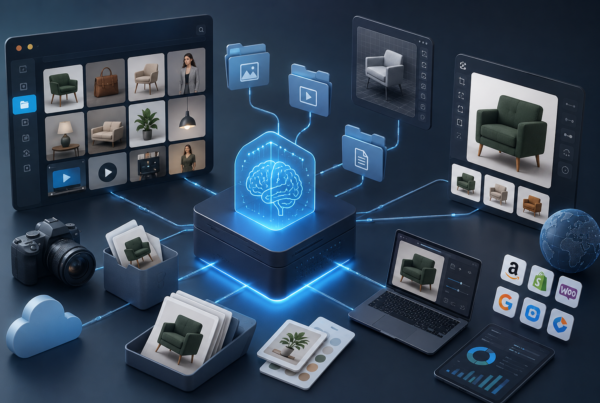
The biggest advantage of ai generated product photography is scalability. Instead of photographing every product variation separately, brands can create multiple versions using one source asset and AI-driven rendering.
For example, a furniture company can generate the same sofa in different colors, fabrics, room settings, and camera angles without physically producing every version. A cosmetics brand can show seasonal campaign variations without rebuilding the entire studio setup.
This creates enormous efficiency for businesses with fast product turnover or international campaigns. Teams can localize content for different markets, test new visuals for advertising, and prepare launch materials much earlier in the product development cycle.
Another major benefit is consistency. Traditional photography often varies depending on location, lighting, and production teams. AI generated product photography helps standardize the brand’s visual language so every image matches the same professional presentation.
This improves customer trust, strengthens branding, and reduces visual confusion across product pages and campaigns.
How AI for Product Photography Improves Speed and Quality
Using ai for product photography combines automation with precision. Instead of replacing creative teams, AI helps them work faster by reducing repetitive manual tasks and improving workflow efficiency.
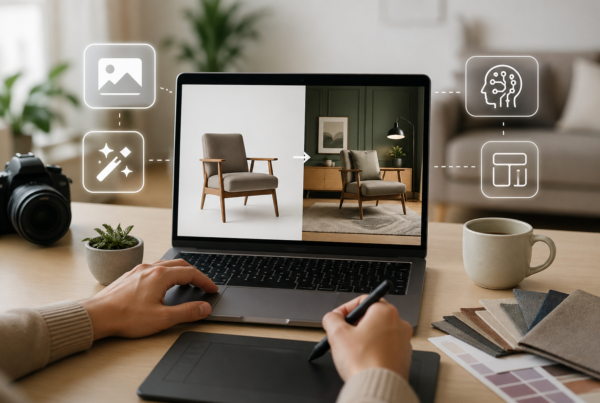
AI can automatically generate new backgrounds, improve lighting, adjust shadows, optimize reflections, remove imperfections, and create platform-specific formats for websites, marketplaces, and social media. This allows teams to focus more on strategy and creative decisions rather than repetitive editing.
For product-heavy industries, speed matters. Delays in product visuals often delay marketing campaigns and sales opportunities. With ai for product photography, businesses can move faster from product launch to customer conversion.
This is especially valuable in product visualization where 3D rendering and AI work together. Instead of relying entirely on traditional photography, brands can generate highly realistic product images that look like premium studio photography while remaining fully editable.
The result is better control over both quality and timing.
When to Use AI for Product Photography in Business Workflows
Knowing when to use ai for product photography is just as important as understanding how the technology works. AI is most effective when businesses need flexibility, speed, and scalable production.
One of the best use cases is pre-launch marketing. Companies can create campaign visuals before physical products are manufactured or delivered. This shortens time-to-market and allows faster sales preparation.
Another strong use case is product variation management. Instead of photographing every material, color, or finish separately, AI can generate multiple versions from one master asset. This is particularly useful for furniture, home décor, and fashion brands with many customization options.
Businesses also use ai for product photography when updating seasonal campaigns. Existing product assets can be transformed into new scenes for holiday promotions, regional campaigns, or platform-specific content without repeating the original production process.
For companies with large catalogs, this creates major cost savings while maintaining high visual standards.
AI is not simply about replacing photography—it is about making product visualization smarter and more efficient.
Choosing the Right AI Tools for Product Photography
The success of AI visuals depends heavily on choosing the right ai tools for product photography. Not all platforms deliver the same level of realism, control, or scalability.
High-quality tools should support realistic rendering, flexible editing, accurate product dimensions, and strong consistency across multiple outputs. For product visualization, realism is essential because customers need to trust that what they see matches the real product.
The best ai tools for product photography also allow businesses to create multiple perspectives, lifestyle scenes, color variations, and marketing assets from one product source. This supports both operational efficiency and stronger creative flexibility.
Brands working with furniture or industrial products often benefit most from AI systems that combine 3D rendering with image generation. This allows highly detailed product presentation without depending entirely on physical photography.
An effective ai product photography generator should also fit naturally into existing workflows. Teams need tools that support collaboration, fast revisions, and easy adaptation across websites, paid media, and marketplaces.
Technology should reduce friction, not create more complexity.
Why AI Product Visualization Is Becoming the New Standard
The demand for visual content continues to grow, but traditional production methods are often too slow to keep up. Brands need faster launch cycles, more content variations, and stronger consistency across every digital channel.
This is why ai product photography is becoming a standard rather than an experiment. It supports faster workflows, lower production costs, and better scalability without sacrificing visual quality.
For eCommerce brands, the ability to generate visuals quickly can directly affect sales performance. Products that launch faster, look more professional, and remain visually consistent often convert better and create stronger customer confidence.
AI also supports better testing. Marketing teams can quickly compare multiple creative directions, seasonal campaigns, and ad variations without restarting the entire production process.
The use of an ai product photography generator gives brands more control over their content strategy while reducing dependence on repeated physical production.
As digital commerce becomes more competitive, businesses that use AI strategically gain a major advantage.
Understanding ai generated product photography, knowing when to use ai for product photography, and choosing the right ai tools for product photography allows brands to move faster, market smarter, and present products with far greater impact.
AI is no longer just a tool for experimentation—it is becoming one of the strongest foundations of modern product marketing.