
Product visuals have always been one of the most important elements in eCommerce. Customers rely on images to understand what they are buying, how a product looks in real life and whether it fits their expectations. However, producing high-quality product images at scale has traditionally been expensive, time-consuming and difficult to manage.
This is where we are changing the landscape. Instead of relying on photo shoots, studios and manual editing, brands can now use AI to create product images faster, more flexibly and at scale.
By combining automation and visual consistency, AI enables companies to create high-quality images that support both product presentation and marketing without the constraints of traditional workflows.
AI tools for product images: Simplifying content creation at scale
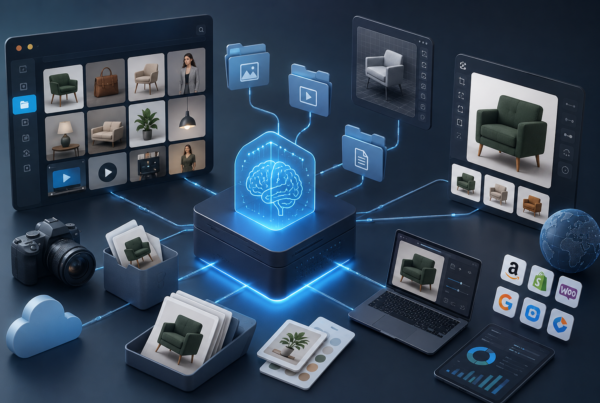
Modern AI tools for product images are designed to reduce the complexity of content creation. Instead of organizing multiple photo shoots for each product variant, brands can generate imagery using existing resources such as product photos or 3D models.
This shift has a significant impact on how teams operate. Content creation becomes more efficient, and businesses can respond faster to new product launches, seasonal campaigns or changes in marketing strategy.
AI tools also make it easier to maintain visual consistency. Instead of relying on different photographers, locations or lighting conditions, brands can create a unified style across all product images. This consistency is particularly important for eCommerce, where visual clarity directly affects customer perception.
In practical terms, AI-powered tools allow businesses to:
-
- generate lifestyle images without physical setups
- adapt backgrounds, lighting and environments instantly
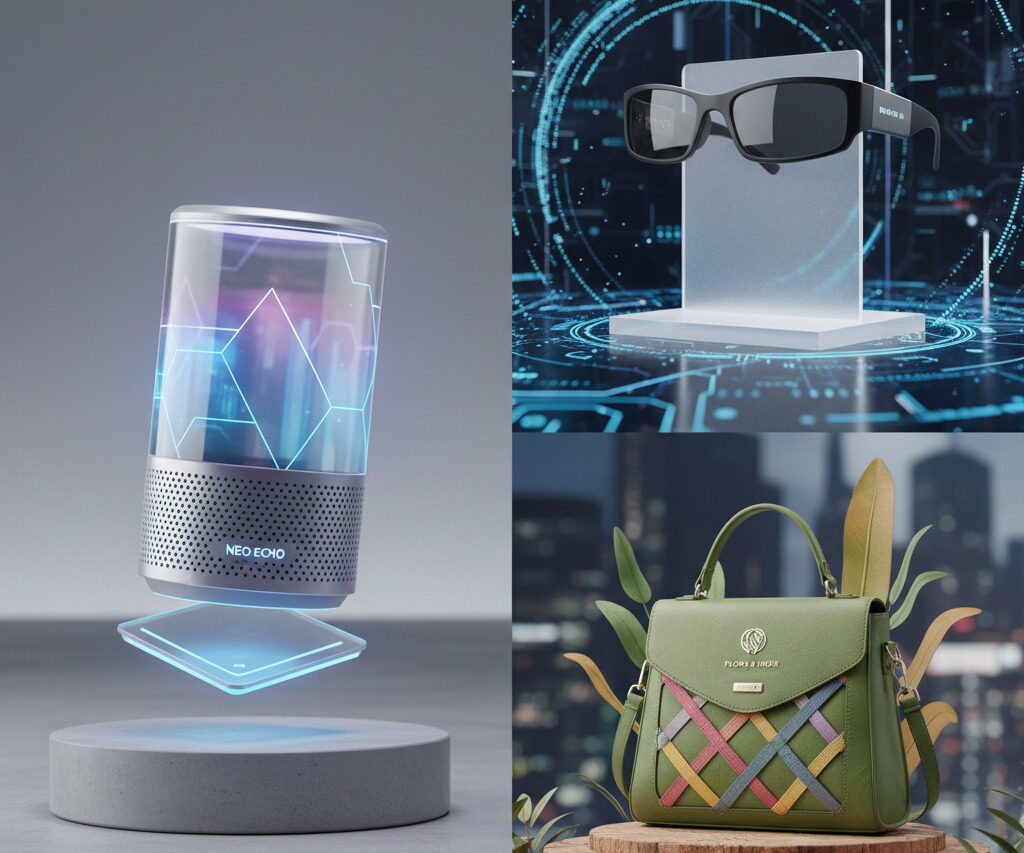
- create multiple variations of the same product for different channels
- scale content production across large product catalogues
By simplifying these processes, AI tools help reduce both production time and operational costs.
AI for creating product images: from static assets to dynamic visuals
The concept of ai for creating product images goes beyond simple automation. It introduces a new way of thinking about visual content, where images are not fixed outputs but flexible assets that can be adapted as needed.
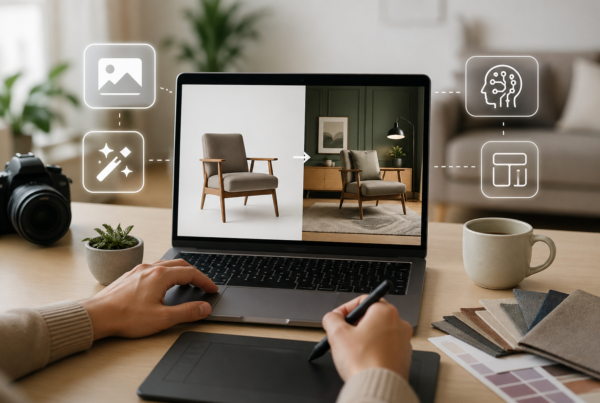
Traditionally, each image required a separate photoshoot. With AI, a single product input can generate multiple outputs, including lifestyle scenes, studio images or campaign visuals. This makes it easier for brands to experiment with different styles and formats without additional production effort.
This flexibility is especially valuable for marketing teams. Campaigns often require multiple versions of the same product image, tailored to different audiences or platforms. AI makes it possible to generate these variations quickly and efficiently.
At the same time, it supports faster time-to-market. New products can be visualised and published without waiting for physical production or photography, which allows businesses to launch campaigns sooner.
Improving consistency and brand presentation
Consistency is a key factor in building a strong brand identity. When product images vary in style, lighting or quality, it can create confusion and reduce trust.
AI for creating product images helps address this by standardising visual output. Brands can define a consistent style and apply it across all images, ensuring that every product is presented in a cohesive way.
This is particularly important for large product catalogues, where maintaining consistency manually can be difficult. AI ensures that all images follow the same visual guidelines, regardless of the number of products or variations.
It also allows brands to update visuals easily. If a company decides to change its visual style, AI-generated images can be adapted without reshooting products, saving both time and resources.
AI for e-commerce product images: enhancing the online shopping experience
In eCommerce, product images play a direct role in customer decision-making. Clear, high-quality visuals help customers understand products and reduce uncertainty before purchase.
AI for e-commerce product images enhances this experience by providing more engaging and informative visuals. Instead of relying on a limited number of images, brands can offer a wider range of perspectives and contexts.
For example, products can be shown in different environments, styles or use cases, helping customers imagine how they would fit into their own lives. This is particularly valuable for categories such as furniture, where context plays a critical role.
AI-generated images also support faster updates. When product details change or new variations are introduced, visuals can be updated quickly without organising new photoshoots.
From a business perspective, this leads to several advantages:
-
- improved product presentation across digital channels
- increased customer engagement with product pages
- better understanding of product features and use cases
- faster adaptation to market trends and campaigns
These factors contribute to a more effective and competitive eCommerce strategy.
AI product images generator: automating and scaling visual production
An ai product images generator is at the core of this transformation. It allows brands to automate the creation of product visuals while maintaining control over quality and style.
Instead of producing images one by one, businesses can generate multiple visuals simultaneously. This is particularly useful for companies with large inventories or frequent product updates.
Automation also reduces dependency on manual processes. Teams no longer need to coordinate complex production workflows, which simplifies operations and reduces the risk of delays.
Another important advantage is scalability. As businesses grow, their content needs increase. An AI product images generator allows organisations to scale visual production without significantly increasing costs or resources.
This makes it easier to maintain a consistent and up-to-date product catalogue, even as the number of products expands.
Supporting multi-channel marketing and campaigns
Modern eCommerce requires content for multiple channels, including websites, social media, marketplaces and advertising platforms. Each channel may require different formats, styles or variations of product images.
An ai product images generator supports this by enabling brands to create multiple versions of the same product quickly. Images can be adapted for different campaigns, audiences or platforms without starting from scratch.
This flexibility allows marketing teams to experiment with different approaches and optimise content based on performance. It also ensures that visuals remain relevant and aligned with current trends.
By reducing the time required to produce content, AI enables teams to focus more on strategy and creativity rather than execution.
Why businesses are adopting AI for product image creation
The adoption of AI in content creation is driven by the need for efficiency, scalability and flexibility. Traditional methods are often too slow and resource-intensive to meet the demands of modern eCommerce.
By using ai for e-commerce product images, businesses can streamline their workflows and produce high-quality visuals more efficiently. This not only reduces costs but also improves the overall customer experience.
AI also supports innovation. Brands can explore new ways of presenting products, experiment with different styles and create more engaging visual content.
At the same time, it allows organisations to remain competitive. As more businesses adopt AI-driven solutions, those that rely solely on traditional methods may struggle to keep up.
Key considerations when using AI tools for product images
While AI offers significant advantages, it is important to implement it strategically. Businesses need to ensure that AI-generated images align with their brand identity and meet customer expectations.
When evaluating ai tools for product images, organisations should consider:
-
- the quality and realism of generated images
- the ability to maintain a consistent visual style
- flexibility in creating different variations and formats
- integration with existing workflows and platforms
These factors help ensure that AI is used effectively and delivers meaningful results.
Conclusion
The way product images are created is changing rapidly. Traditional methods, while still relevant in some contexts, are no longer sufficient to meet the demands of modern eCommerce.
By using solutions that create product images with ai, businesses can produce high-quality visuals faster, more efficiently and at scale. Ai tools for product images simplify content creation, while ai for creating product images introduces flexibility and adaptability into the process.
At the same time, ai for e-commerce product images enhances the customer experience by providing more engaging and informative visuals. An ai product images generator supports automation and scalability, allowing businesses to manage growing content needs effectively.
As visual content continues to play a central role in online shopping, organisations that adopt AI-driven approaches will be better positioned to improve product presentation, optimise workflows and stay competitive in a rapidly evolving market.